
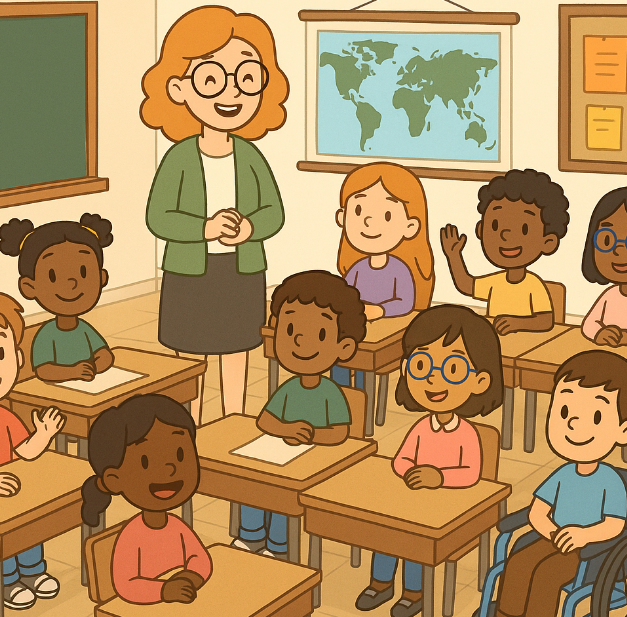
Which Kids Thrive in Inclusive Classrooms? New Autism Research Reveals Unexpected Clues
One preschooler spent just 2.3 seconds looking at a smiling adult—and that tiny moment predicted an entire year of developmental growth.
Yes, you read that right. Two-point-three seconds.
That’s the kind of eyebrow-raising detail tucked inside a major study on early childhood education for autistic children—one that challenges some assumptions many parents and educators hold about inclusive classrooms.
And if you work in a school, raise a neurodivergent child, or help shape early childhood supports, this new research deserves your attention.
The Big Question Every Parent and School Team Asks
When a child is diagnosed with autism, one of the first decisions families and educators grapple with is placement: Should the child learn in an inclusive classroom with typically developing peers, or in a specialized autism-specific program?
It’s a nerve-wracking decision—partly because the stakes feel high, and partly because the research has historically been mixed.
But a team of researchers (Vivanti et al., 2022) dug into this question with unusual precision. Instead of comparing different programs, teachers, or curricula, they controlled for all of that. Every child—whether placed in an inclusive or specialized setting—received the same evidence-based intervention: the Group Early Start Denver Model (G-ESDM).
This means something huge: The only difference between children’s experiences was the classroom environment and the peers around them.
A Surprising Finding: On Average, Both Settings Worked Equally Well
Across the sample of 58 preschoolers, children made progress regardless of classroom type. Results show clear upward movement in social interaction, vocalizations, and verbal developmental scores over one year, with no overall advantage for inclusive or specialized settings.
That alone is comforting: Parents aren’t “ruining” anything by choosing one path or the other.
But here’s where the study gets fascinating.
The Real Story: Some Kids Benefit More from Inclusion—But Only When They Start With Certain Strengths
The researchers discovered something striking when they zoomed in on children’s starting characteristics. Two traits—measured at intake using eye-tracking and standardized developmental assessments—predicted who would thrive most in inclusive settings:
1. Higher Nonverbal Cognitive Skills
Children with higher nonverbal developmental scores made larger gains in vocalizations only when placed in inclusive classrooms. Kids with lower nonverbal skills didn’t show the same boost.
2. Interest in Social-Emotional Cues
One of the eye-tracking tasks showed children a video of a playful adult making warm, engaging expressions. Researchers measured how long each child kept their eyes on her face. The results were astonishing:
- For children who paid more attention to the adult’s face, inclusive settings led to bigger improvements in social interaction.
- For children who paid less than 2.37 seconds, inclusive environments were actually less beneficial.
Let’s pause there. This doesn’t mean “low social interest = no inclusion.” It means kids who aren’t yet tuned into social cues may need extra support before they can fully benefit from peer-rich settings.
This nuance is powerful—and actionable.
Why These Traits Matter
Inclusive classrooms offer something specialized settings can’t: Constant access to socially rich models—typical peers who demonstrate language, play, emotion, and problem-solving skills throughout the day. But to learn from those opportunities, a child has to:
- notice social cues
- stay engaged long enough to interpret them
- imitate or respond in a way that builds learning loops
Children with higher baseline social engagement and stronger nonverbal cognitive skills are more likely to use these natural “micro-moments” of learning.
For those who aren’t yet tuned in, inclusive environments may feel overwhelming, unpredictable, or simply confusing.
Why This Isn’t a “Choose Inclusion or Don’t” Story
Some advocates might be tempted to read this study as saying, “Only some kids benefit from inclusion.” But that’s not what the data show.
Every child improved across the year, in both settings.
And the researchers themselves emphasize that:
- This study took place in classrooms where staff were highly trained in G-ESDM.
- Many real-world inclusive classrooms lack this level of structure.
- Inclusive placements still have major social and ethical benefits.
Most importantly, the authors highlight this takeaway: Children with lower social interest may benefit from targeted supports to help them fully access the benefits of inclusion.
What This Means For Parents and School Teams
Here’s the good news: You don’t need an eye-tracking lab to use these insights. Educators and caregivers can look for everyday behaviors that reflect the traits identified in the research:
Signs a Child May Especially Thrive in Inclusion
- Watches peers play and seems curious
- Looks at adults’ faces when they speak or smile
- Copies gestures, actions, or sounds
- Enjoys shared routines like peek-a-boo or circle time
Signs a Child May Need Extra Support Before Inclusion Feels Beneficial
- Rarely looks toward faces, even familiar adults
- Seems overwhelmed by noise, activity, or fast-paced group routines
- Struggles to imitate simple actions
- Has difficulty shifting or following play
None of these are dealbreakers. They’re simply indicators of what supports might matter most.
Practical Takeaways for Schools
Want to help every child access the benefits of inclusion? Here’s what the research points toward:
1. Build social-interest boosters into everyday routines
Small interventions—like playful face-to-face routines—can strengthen the very skills that predict gains in inclusive settings.
2. Provide structured opportunities for peer learning
Peer-mediated approaches work especially well when adults coach peers to model and reinforce social behaviors.
3. Match supports to readiness—not labels
A child with high social interest may thrive in inclusion regardless of expressive language level.
A child with low social interest may succeed in inclusion with targeted, early supports.
4. Remember: One size never fits all
This research supports personalized placement decisions, not blanket recommendations.
A Thoughtful Conclusion
At its heart, this study reminds us that inclusion isn’t a place—it’s a process.
Children aren’t “ready” or “not ready.” They’re growing, learning, and responding to environments in unique ways. And with the right supports—especially those that strengthen social engagement—more children can access the full social richness of inclusive classrooms.
Let’s Talk About It
What do you think?
- What’s the biggest mental health or learning challenge you see in early childhood settings today?
- How can schools better support autistic students’ emotional and social development?
- What’s one insight about children’s social engagement that has changed how you teach or parent?
Share your thoughts. This conversation pushes us closer to classrooms where every child can thrive.