

Flexible Instruction Days (FIDs) vs. Snow Days: Evidence on Learning, Equity, and Student Well-Being
Flexible Instruction Days (FIDs)—also called “e-learning days” or “virtual snow days”—aim to count weather closures as instructional days. Direct peer-reviewed research on weather-triggered, 1–5-day-per-year FID programs is limited, so districts rely on (1) studies on weather closures and absences, (2) K–12 online-learning research, and (3) COVID-era remote-learning evidence. Three takeaways are best supported: a small number of traditional snow days has little measurable effect on test scores, but weather-related absences do; remote instruction can depress achievement growth and widen gaps when access/engagement are uneven; and equity (technology, disability access, language access) must be treated as a design constraint. For school psychologists, the practical implication is to design FIDs as “continuity and connection days”: brief routines, review/retrieval practice, and a low-stakes relational check-in—rather than pace-forward lessons that assume universal participation.
What Flexible Instruction Days are and why districts use them
An FID is a pre-approved plan to deliver instruction when school cannot operate normally, allowing the closure to count as “in session” (often with a state cap). The model spread post-2020 because many districts already had devices and learning platforms.
District motives are mostly logistical: avoid extending the school year and maintain instructional day/hour compliance. The core challenge is that snow/ice events can also reduce at-home participation (outages, caregiver constraints, platform failures).
What the evidence says about learning outcomes and engagement
The best direct evidence on “snow days” comes from weather-shock studies. In one widely cited analysis, moderate snowfall increased student absences while extreme snowfall increased closures; each weather-induced absence reduced math achievement, while closures showed little measurable impact on test scores.
The strongest caution about FIDs comes from COVID-era remote learning: large-scale analyses found lower achievement growth and widened gaps when instruction shifted remote, with disproportionate losses in high-poverty contexts. A single FID is not comparable to months of remote schooling, but the risk mechanisms—uneven participation and weaker feedback loops—are similar.
International systematic reviews of pandemic-era remote learning also tend to find negative academic effects, with motivational and socio-emotional factors implicated—relevant because FID days rely heavily on students’ self-regulation and home supports.
A major federal meta-analysis emphasized that rigorous K–12 online-learning comparisons were relatively scarce, reinforcing the idea that effectiveness depends on strong design and supports.
Equity, access, and student well-being
National data show that most children have home internet, but gaps remain (including smartphone-only access, no internet access, and lower fixed-broadband rates in rural areas). For FIDs, “access” also means a device-per-child, a quiet workspace, and adult support—conditions that vary systematically by poverty and geography.
For students with disabilities, FID plans must be accessible by design and specify how IEP/504 supports and related services are delivered or compensated. Federal guidance during COVID reiterated ongoing obligations to provide a FAPE when instruction moves to remote settings, including through special education planning processes and nondiscrimination requirements.
For legal clarity and implementation planning, districts commonly look to Office of Special Education and Rehabilitative Services and Office for Civil Rights materials emphasizing that disability and civil-rights duties continue during distance learning.
For English learners, districts should anticipate language-access needs (translations, interpretation, scaffolds) and build low-tech participation pathways alongside online tasks.
Well-being evidence is mostly based on sustained remote learning, but it links virtual learning to higher stress and reduced connectedness versus in-person. FIDs should therefore prioritize brief check-ins and realistic workload rather than screen-heavy schedules.
Attendance, assessment integrity, and teacher workload
Participation is the “make-or-break” variable. Research suggests remote-only exposure in 2020–21 was associated with persistent attendance declines, and chronic absenteeism remains elevated in many districts—so any “school at home” policy should be paired with clear routines and monitoring.
Assessment integrity is another predictable friction point. Remote-assessment research emphasizes authorship safeguards and meaningful task design; other evidence suggests unproctored online exams can be valid in some contexts with careful design. For FIDs, avoid high-stakes tests; use short formative checks and “show your reasoning” artifacts.
Teacher workload is an implementation constraint. National survey work continues to show high stress/burnout in teaching, and even traditional snow days often still involve email work; sustainable FIDs require explicit boundaries (required minutes, grading expectations, tech support triage).
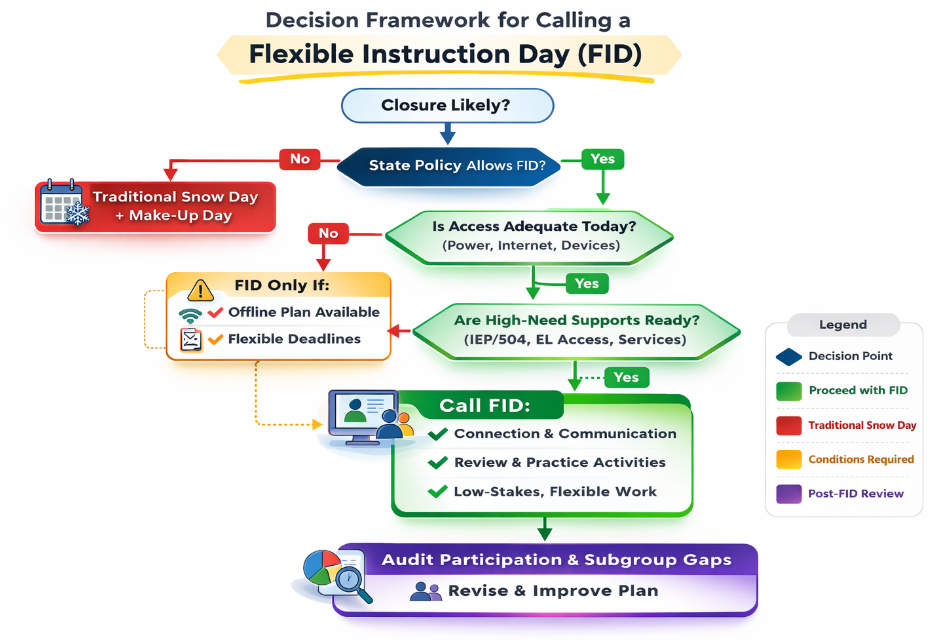
Implementation models, cost/logistics, and decision flowchart
A practical “default” is a hybrid model: brief live check-in (attendance + connection), asynchronous practice, and an offline option. This balances structure with outage reality and reduces the harm if participation is uneven across subgroups.
Cost and logistics mostly shift upstream: devices, learning-management-system capacity, connectivity supports, multilingual communication, and printing/distribution of offline materials. National Center for Education Statistics survey reporting indicates that by 2021–22 almost all public schools provided digital devices to students who needed them, but home internet access is not universal and rural fixed broadband lags other locales; districts that want equitable FIDs commonly budget for home connectivity support (hotspots or partners), an on-call help desk, and pre-printed offline packet
| Model | Equity/access profile | Workload profile | When it tends to be most defensible |
|---|---|---|---|
| Synchronous (live periods) | Lowest fit where outages/connectivity are common; higher caregiver dependence in elementary. | High day-of staffing + tech load. | Secondary grades; stable infrastructure. |
| Asynchronous (deadline-based) | Better under outages; higher executive-function burden. | Prep-heavy; lighter day-of. | Review/reading practice; mixed access. |
| Hybrid + offline option | Strongest equity case when offline pathways are real and normalized. | Highest upfront planning; steadier day-of. | Inclusive K–12 plans. |
Practical recommendations and takeaways
For teachers
Use FIDs to protect continuity: retrieval practice, reading, and prior-skill reinforcement tend to be more robust to uneven participation than new content. Keep synchronous time brief; design tasks that work online or offline.
For school boards and district leaders
Treat the FID plan as an equity and compliance document: define attendance, accommodations, language access, and service-delivery procedures; align caps and hour/minute requirements with state rules; and require annual reporting of participation and subgroup gaps.
For parents and caregivers
Ask early: “What counts as participation?” and “What’s the offline option if internet or power fails?” Build a simple routine and communicate constraints quickly.
For school psychologists and MTSS teams
Assume that one-day remote learning will be “high-variance”: some students thrive, but students with anxiety, attention/executive-function vulnerabilities, or limited home supports are more likely to disengage. Build FID-specific supports (brief check-ins, clear help-seeking pathways, and flexible deadlines for documented access barriers), and use participation data to identify who needs re-entry support the next day.