
Montessori Education Explained: What It Is, How It Works, and What the Science Says
Parents hear the word Montessori everywhere—on preschools, toys, bookshelves, and Instagram reels. It’s often associated with calm classrooms, independent children, and beautiful wooden materials. But what is Montessori education really? And more importantly, does it work?
This article explains the Montessori method in plain language and summarizes what decades of research—including studies published in Science and npj Science of Learning—tell us about its effectiveness for children’s learning, social development, and long-term outcomes
What Is Montessori Education?
Montessori education was developed over 100 years ago by Dr. Maria Montessori, one of the first female physicians in Italy. Her background in medicine and child development led her to a simple but radical insight: children learn best when they are active participants in their own learning, not passive recipients of instruction.

At its core, Montessori education is built around a dynamic relationship between the child, the teacher, and the environment
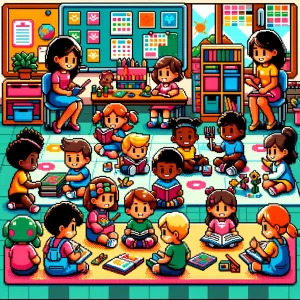
Key Features of Montessori Classrooms
While Montessori schools vary, high-fidelity programs tend to share several defining characteristics:
- Mixed-age classrooms (typically 3–6, 6–9, or 6–12 years)
- Uninterrupted work periods (often 2–3 hours)
- Student choice in activities, pacing, and sequencing
- Specialized learning materials designed for hands-on exploration
- Minimal reliance on grades, tests, or extrinsic rewards
- Teachers as guides, not lecturers
The goal is not just academic achievement, but the development of concentration, independence, self-regulation, social responsibility, and intrinsic motivation.
The Montessori Learning Materials: More Than Pretty Objects
One of the most distinctive aspects of Montessori education is its learning materials. These are not toys or worksheets—they are carefully engineered tools designed to teach specific concepts through movement and sensory experience
How Montessori Materials Work
Montessori materials share several design principles:
- One concept at a time: Each material isolates a single idea (e.g., size, quantity, sound), reducing cognitive overload.
- Concrete before abstract: Children physically manipulate objects before moving to symbols or numbers.
- Built-in error correction: Materials allow children to notice and fix mistakes on their own, without adult judgment.
- Progression across subjects: Early materials prepare children for later work in math, literacy, science, and geography.
For example:
- The Pink Tower teaches size gradation and spatial reasoning.
- Number rods introduce quantity before symbols.
- Sandpaper letters link sound, movement, and visual form to support early literacy.
The Montessori Work Cycle: Why Long Periods Matter
Another major difference from conventional schooling is the long, uninterrupted work cycle. Rather than switching activities every 20–30 minutes, Montessori classrooms often allow children two to three hours to choose, repeat, and deepen their work
Research in cognitive science suggests this structure supports:
- Sustained attention
- Executive function (planning, flexibility, inhibition)
- Deeper learning and mastery
The teacher’s role during this time is observational and responsive—introducing new materials when a child is ready, redirecting gently when needed, and facilitating small-group lessons.
Does Montessori Education Work? What the Research Says
Despite Montessori’s popularity, rigorous evaluations are surprisingly rare. That makes the studies that do exist especially important.
One of the Strongest Studies: A Lottery-Based Design
A landmark study published in Science compared children who attended a public Montessori school with children who applied but were not admitted through a random lottery. This design helped control for parental motivation and background—one of the biggest challenges in education research.
Key Findings for 5-Year-Olds
Children who attended Montessori showed:
- Higher scores in early reading and math
- Stronger executive function
- More advanced social reasoning
- Greater concern for fairness and justice
- More positive peer interactions on the playground
These differences were not small, and they occurred in areas typically hard for schools to influence.
Findings for 12-Year-Olds
By early adolescence, Montessori students:
- Wrote more creative and complex stories
- Chose more constructive responses to social dilemmas
- Reported a stronger sense of classroom community
Interestingly, standardized test differences in reading and math were no longer evident at this age, suggesting either “catch-up” by peers or that Montessori’s advantages lie more in how children think and relate, not just test performance.
Why Fidelity Matters: Not All Montessori Is the Same
One of the clearest conclusions from the research is that Montessori works best when it is implemented faithfully. Studies reviewed in npj Science of Learning show that:
- High-fidelity Montessori classrooms outperform both conventional classrooms and low-fidelity Montessori programs
- The amount of time children actually spend using Montessori materials predicts gains in executive function, literacy, and vocabulary
When Montessori classrooms dilute the model—shortening work periods, adding worksheets, or emphasizing grades—benefits are often reduced or disappear altogether.
What About Academic Achievement?
Parents often ask: Will my child keep up academically in a Montessori school? The evidence suggests:
- Early academic skills (especially literacy and math) are often as strong or stronger in Montessori
- Long-term test score advantages are mixed
- Montessori students often show strengths in writing, creativity, motivation, and social skills
This makes sense when you consider Montessori’s goals. The method prioritizes how children learn, not just what they score.
Montessori and Executive Function: A Hidden Strength
One of the most consistent findings across studies concerns executive function—skills such as attention control, flexibility, planning, and self-regulation.
Montessori classrooms naturally train these skills through:
- Choice and responsibility
- Extended concentration
- Self-correction
- Peer collaboration
- Minimal external rewards
Executive function is a powerful predictor of long-term success—sometimes more so than IQ or early academic scores.
Is Montessori Right for Every Child?
No educational approach is perfect for every family or child. Montessori tends to work best for children who:
- Enjoy independence and hands-on learning
- Benefit from structure without constant adult direction
- Thrive in mixed-age social settings
It may be less ideal for children who:
- Strongly prefer direct instruction
- Struggle with open-ended choice without additional support
- Need frequent external feedback or structure
Importantly, Montessori is not “hands-off.” High-quality programs involve highly trained teachers who intervene thoughtfully and intentionally.
What Parents Should Look for in a Montessori School
Because the name “Montessori” is not legally protected, quality varies widely. Parents should ask about:
- Teacher training and certification
- Length of uninterrupted work periods
- Use of authentic Montessori materials
- Mixed-age groupings
- Approach to assessment and discipline
A school calling itself Montessori is not enough—implementation matters.
The Bottom Line
The best available evidence suggests that well-implemented Montessori education can foster strong academic foundations, social skills, creativity, executive function, and intrinsic motivation—often matching or exceeding traditional schooling in meaningful ways.
Montessori is not a shortcut or a miracle cure. It is a carefully designed educational ecosystem that aligns remarkably well with what modern science tells us about how children learn.
For parents seeking an approach that supports both the mind and the whole child, Montessori remains one of the most compelling—and scientifically grounded—options available.