
Exeter Class of 2026: Where Graduates Are Headed Next
For years, one of the biggest stories in Exeter’s graduation data was uncertainty. In 2022, nearly four out of every ten graduating seniors either hadn’t announced a plan or weren’t sure what came next.
Four years later, that uncertainty has largely disappeared.
The Class of 2026 is not only more likely to have a post-graduation plan but also more likely to pursue a wider variety of options, including college, community college, trade programs, and direct entry into the workforce.
For the fifth year in a row, I took a deep dive into where Exeter High School graduates say they’re headed after graduation.
A few years ago, this started as a simple curiosity project. As someone interested in youth development, education, and the future of our community, I wanted to know what happened after students walked across the stage. So I began collecting and coding the post-graduation plans shared publicly by Exeter on seniors on their Facebook page
What began as a snapshot of a single graduating class has now become a five-year dataset spanning the Classes of 2022 through 2026.
And this year’s results reveal something important: Exeter students aren’t abandoning college. They’re becoming more intentional about their choices.
The data suggests that today’s graduates are entering adulthood with clearer plans, more diverse pathways, and a broader definition of what success looks like after high school.
The Class of 2026 at a Glance
This year’s graduating class included 344 students with publicly reported post-graduation plans.
The largest group remains college-bound students.
- 179 students (52.0%) plan to attend a four-year college or university
- 53 students (15.4%) plan to enter the workforce
- 45 students (13.1%) did not publicly report plans
- 31 students (9.0%) plan to attend community college
- 29 students (8.4%) plan to enter trade or technical programs
- 7 students (2.0%) plan to enter military service
The accompanying Sankey diagram provides a visual map of these pathways, showing how students move from broad categories such as “college” into specific destinations and institution types.
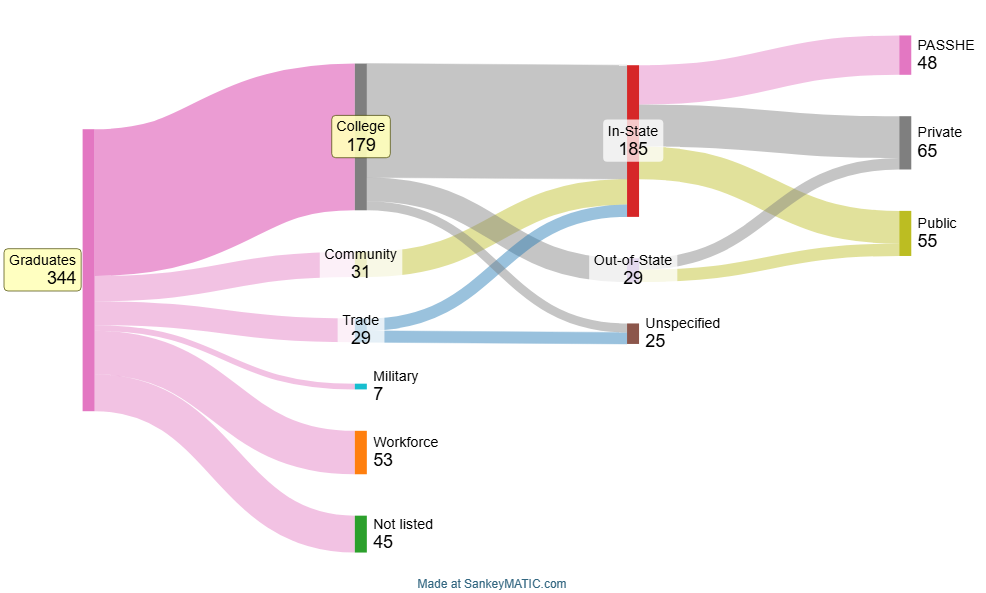
What immediately stands out is that more than half of Exeter graduates are still pursuing a traditional college education. But that’s only part of the story.
The Biggest Story Isn’t College. It’s Certainty.
The most dramatic change in the data isn’t an increase in college enrollment. It’s the continued collapse of the “undecided” category. Back in 2022, nearly 40% of Exeter graduates did not publicly report a clear post-graduation plan. Whether that reflected uncertainty (e.g., COVID), delayed decision-making, or simply reduced reporting, it accounted for a substantial share of the graduating class.
Today, that figure has fallen to just 13.1%. That’s a remarkable shift. In practical terms, there are 92 fewer students in the undecided category than there were just four years ago.
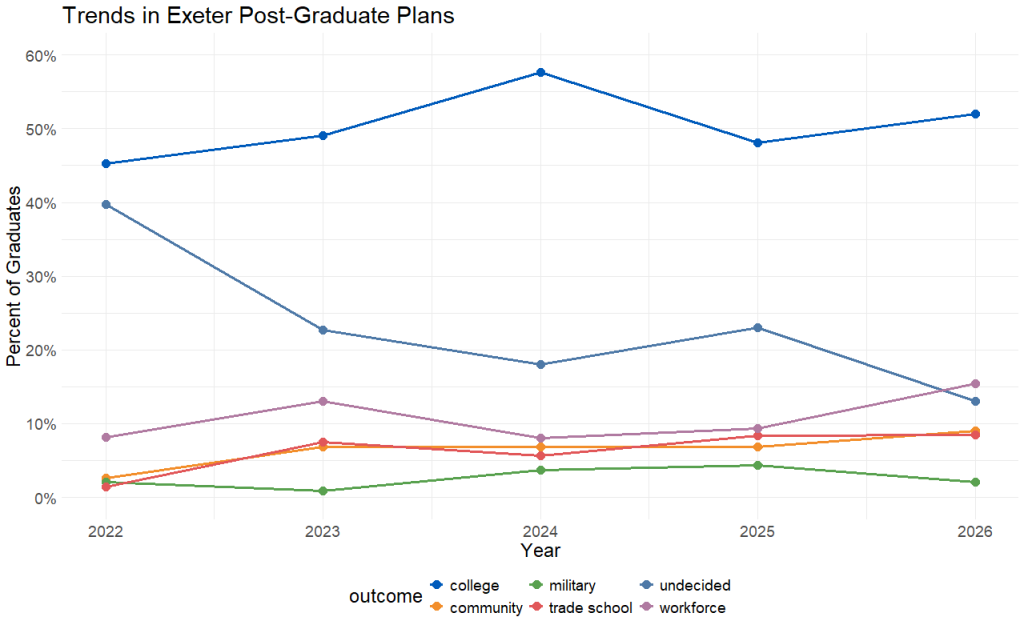
Students appear to be making decisions earlier and communicating those decisions more clearly than they did during the immediate post-pandemic years.
For educators, counselors, and families, this may be one of the most encouraging findings in the entire dataset.
College Remains Strong
Despite ongoing national debates about the value of higher education, Exeter’s college-going rate remains remarkably stable. In fact, college attendance has increased.
- 45.2% in 2022
- 48.1% in 2025
- 52.0% in 2026
Rather than seeing students flee higher education, we’re seeing a gradual increase in the share of students choosing four-year institutions. The college destination data also reveals something else:
Most students continue to stay close to home.
Penn State remains the most popular destination by a wide margin, attracting 30 students from the Class of 2026. Among Pennsylvania’s state universities, West Chester and Kutztown remain major destinations, while Alvernia and Lebanon Valley lead among private institutions.
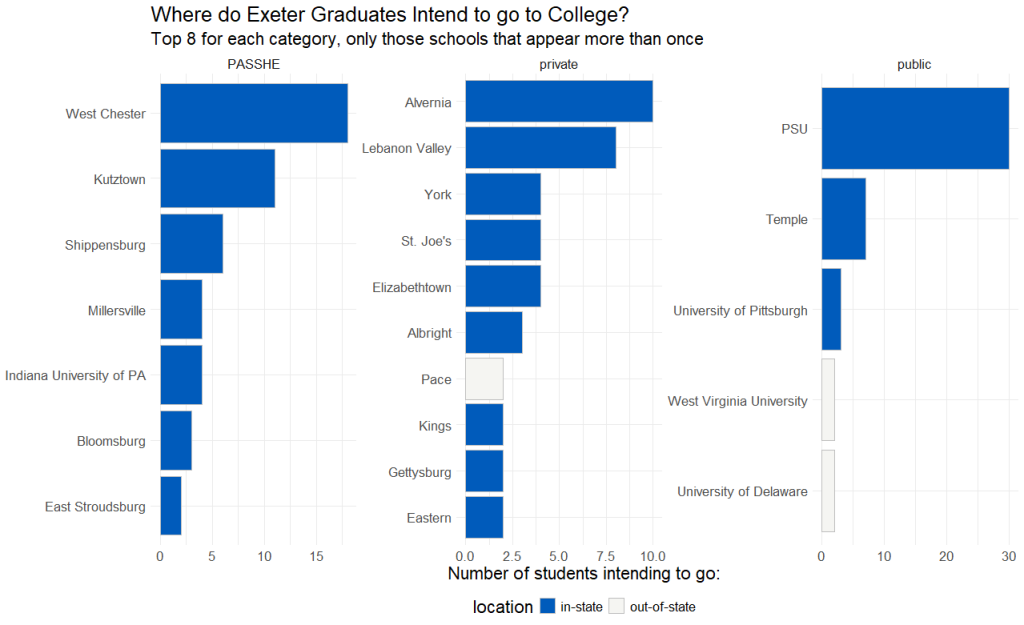
The top destinations reflect a consistent pattern that has emerged over multiple years: students often balance educational opportunities with affordability, familiarity, and proximity to home.
Workforce Entry Is Rising
Twenty years ago, entering the workforce immediately after high school was often viewed as a backup plan. Today’s labor market looks very different. Many employers offer training, certifications, apprenticeships, and career ladders that didn’t exist for previous generations.
In 2025, 30 graduates reported plans to enter the workforce. In 2026, that number jumped to 53. That’s an increase of more than 75% in just one year.
Statistically, workforce participation was one of the outcomes that appeared significantly higher than expected compared to recent historical patterns. There are many possible explanations.
Some students may be pursuing employment opportunities in skilled trades or family businesses. Others may be entering the workforce while delaying further education. Rising college costs, economic uncertainty, and changing perceptions of career pathways may also be playing a role.
The data cannot tell us why students are making these choices. But it clearly shows that more students are making them.
Community College Continues to Grow
Community college may be the most overlooked story in the data. In 2022, only 9 students reported plans to attend community college. By 2026, that number had increased to 31. That’s more than a threefold increase. Community college enrollment was also significantly higher than expected compared to historical patterns. For many students, community colleges offer an attractive combination of affordability, flexibility, workforce preparation, and transfer opportunities.
As concerns about student debt continue to grow nationally, community colleges may be becoming an increasingly important part of the local educational ecosystem.
Trade Schools Have Moved Into the Mainstream
One of the strongest long-term trends involves trade and technical education. In 2022, only five students reported plans to attend trade school. Today, that number stands at 29. While trade school participation remained relatively stable between 2025 and 2026, the broader five-year trend is unmistakable.
Students are increasingly viewing skilled trades as legitimate, respected, and financially attractive career pathways. Given workforce shortages in construction, manufacturing, transportation, and technical fields, this trend could have important implications for the region’s economy over the coming decade.
What Should Exeter Pay Attention To?
The most important lesson from this year’s data is not that one pathway is winning. It’s that students are diversifying their choices. A generation ago, conversations about post-secondary success often focused almost exclusively on four-year college enrollment.
Today’s graduates are telling a different story. College remains important. But so do community colleges. So do apprenticeships and technical programs. So does military service. And increasingly, so does entering the workforce directly.
The challenge for schools is no longer helping students choose college versus not college. The challenge is helping students navigate an expanding menu of high-quality opportunities. That means strengthening career exploration programs, expanding exposure to technical and workforce pathways, and ensuring that students understand the long-term implications of each choice.
Success after high school no longer follows a single road. The Class of 2026 reminds us that there are many routes to a meaningful and productive future.
If these trends continue, Exeter’s graduates could become increasingly important to the local workforce. Berks County employers in healthcare, manufacturing, logistics, construction, and skilled trades continue to face hiring challenges. A growing share of students choosing workforce and technical pathways may help meet some of those needs.
Looking Ahead
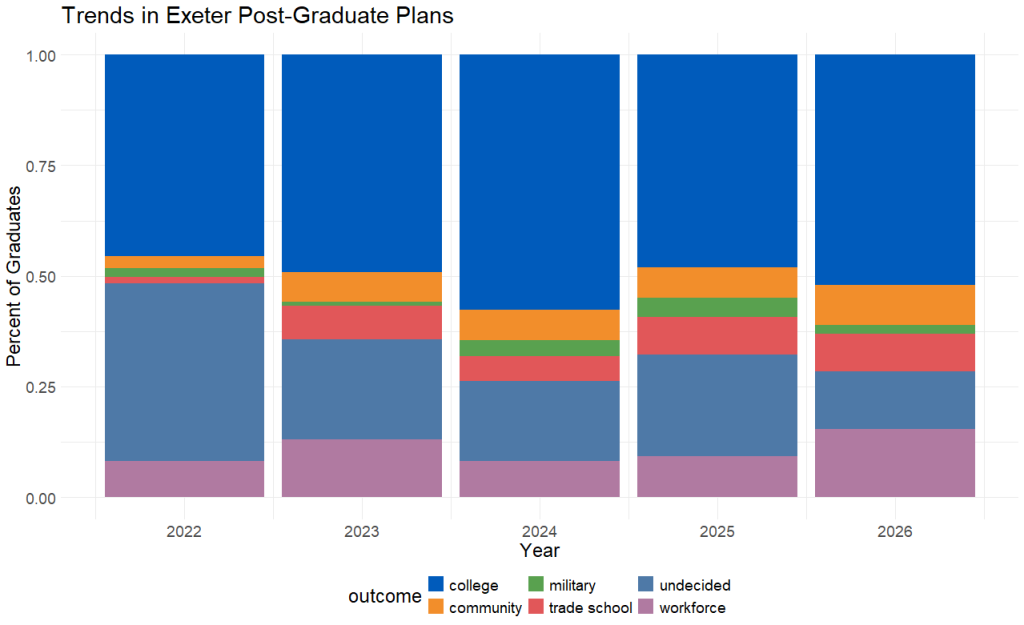
Five years of data reveal a clear pattern. Exeter students are becoming more decisive, more diverse in their plans, and more willing to pursue pathways that fit their individual goals rather than traditional expectations. College remains the dominant destination. But workforce entry, community college enrollment, and trade school participation are all growing.
If these trends continue, the future of post-secondary planning in Exeter may look very different from what it did just a decade ago. It may be a sign that students are finding more ways to define success on their own terms.